
Key Takeaways
- Most people fall asleep in 10-20 minutes—if you're taking way longer, welcome to the club
- The 4-7-8 breathing technique kicks your parasympathetic nervous system into gear fast
- The Military Sleep Method was built to knock soldiers out in 2 minutes (after weeks of practice)
- Cognitive shuffling derails racing thoughts by feeding your brain pointless busywork
- Your hour before bed has more impact than any single technique you try in bed
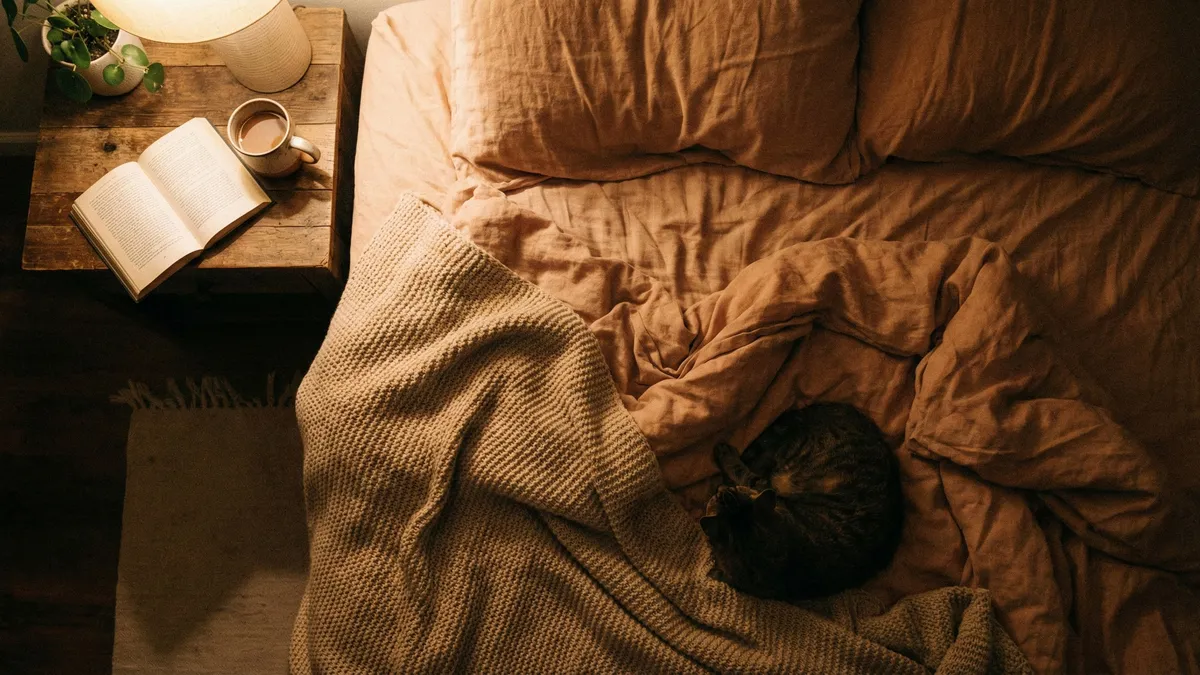
It's 1:47 AM and I'm writing an article about falling asleep. There's a joke in there somewhere. My cat is judging me from the foot of the bed, and honestly, she's right to.
A few years ago, during the worst of my post-divorce insomnia, I would have been staring at the ceiling right now doing mental arithmetic about how many hours of sleep I could still get "if I fall asleep right now." I tried apps, supplements, podcasts, that thing where you tense and release every muscle. Some of it worked. Most of it was garbage. The stuff that actually helped? Backed by real research, free, and nobody had to sell me a $200 weighted blanket.
01 Why You Can't Fall Asleep
Quick detour into what's actually going on in your body when sleep won't come. You're not broken. Your wiring is just doing its job at the wrong time.
Two systems are arm-wrestling at bedtime. Your sympathetic nervous system (fight-or-flight) wants you alert and scanning for threats. Your parasympathetic nervous system (rest-and-digest) wants to shut everything down for the night. When you can't sleep, the sympathetic side is winning. It does not care that the "threat" is a meeting with your boss tomorrow.
The Three Sleep Blockers
Racing Thoughts
Your brain rehashing things you can't do anything about at 2 AM
Physical Tension
Stress camped out in your shoulders, jaw, and breathing
Sleep Anxiety
Stressing about not sleeping, which keeps you from sleeping. Thanks, brain.
All three of these respond to specific techniques. And most of those techniques start working within minutes, once you get the hang of them.
02 Breathing Techniques That Actually Work
Controlled breathing is the fastest way to flip from sympathetic to parasympathetic mode. This isn't wellness fluff—it's basic physiology. Exhale longer than you inhale and you stimulate the vagus nerve, which tells your body to stand down[1].
The 4-7-8 Method
Dr. Andrew Weil developed this one, drawing from pranayama breathing. It's my go-to. Sounds almost stupidly simple. But a 2022 study by Vierra et al. in Physiological Reports found it measurably reduced anxiety and improved sleep quality[2]. I was skeptical too. Then I tried it for a week and stopped being skeptical.
- Exhale completely through your mouth with a whooshing sound
- Inhale quietly through your nose for 4 seconds
- Hold your breath for 7 seconds
- Exhale completely through your mouth for 8 seconds
- Repeat for 4 breath cycles (you can work up to 8)
Pro tip: The exact counts matter less than the ratio. If 4-7-8 feels too long, scale it down—try 2-3.5-4. Just keep the exhale longer than the inhale.
"Breathing is the only autonomic function we can consciously control. Use it."
— Dr. Andrew Huberman, Stanford Neuroscientist
Box Breathing (For Anxious Minds)
When I first tried 4-7-8, holding my breath for 7 seconds while anxious made me more anxious. If that's you, box breathing is a better starting point. It's what Navy SEALs use to stay calm under fire[3], so it can probably handle your Sunday-night dread.
03 The Military Sleep Method
The U.S. Navy Pre-Flight School developed this to help pilots fall asleep in 2 minutes flat. Lloyd Bud Winter documented it in Relax and Win (1981) and claimed a 96% success rate after 6 weeks of practice[4].
I thought it was absurd the first night I tried it. Felt like lying there doing nothing with extra steps. By week three, I was out in under 10 minutes most nights. It takes commitment, but the payoff is real.
- Relax your face. Close your eyes. Let your forehead go slack. Unclench your jaw. Let your tongue fall. Relax the muscles around your eyes.
- Drop your shoulders. Let them fall as low as they'll go. Then relax one arm at a time—upper arm, forearm, hand, fingers.
- Exhale and relax your chest. Feel it sink into the bed.
- Relax your legs. Start with your thigh, then calf, then foot. Repeat on the other side.
- Clear your mind for 10 seconds. Imagine lying in a canoe on a calm lake with clear blue sky above. Or imagine lying in a black velvet hammock in a pitch-black room. If thoughts intrude, repeat "don't think" for 10 seconds.
"The technique requires practice. Don't expect miracles the first night. Expect them after two weeks."
— Lloyd Bud Winter, Relax and Win
04 Cognitive Tricks for Racing Thoughts
Sometimes the problem isn't your body. It's your brain generating a highlight reel of every awkward thing you've ever done. These techniques give it something deliberately boring to chew on instead.
Cognitive Shuffling
Cognitive scientist Luc Beaudoin came up with this, and it's clever. Right before you fall asleep naturally, your thoughts get random and fragmented—images that don't connect to each other. Cognitive shuffling forces that fragmented state artificially, and your brain takes the hint[5].
How Cognitive Shuffling Works
- Pick a random word (like "bedtime")
- For each letter, think of words that start with that letter
- For each word, visualize the object for a few seconds
- Move to the next letter when you run out of words
Example: B → banana (visualize), butterfly, bridge, balloon... E → elephant, envelope, elevator... and so on. I've never made it past the third letter. Not once.
The Paradoxical Intention Technique
Try to stay awake. Seriously.
Broomfield and Espie published a study in Behavioural and Cognitive Psychotherapy showing that people told to keep their eyes open and resist sleep (while lying in bed) actually fell asleep faster than people trying to sleep[6]. The anxiety of chasing sleep is often what keeps you up. Remove the chase, and sleep sneaks in.
Lie in bed, eyes open in the dark, tell yourself "I'm not going to sleep." I felt ridiculous the first time. I was also asleep in about twelve minutes.
05 Body-Based Techniques
If your mind is quiet but your body is still wired—shoulders up by your ears, jaw clamped shut—you need to work on the physical side directly.
Progressive Muscle Relaxation (PMR)
Physician Edmund Jacobson developed this back in the 1930s. It's been around forever because it works. A meta-analysis by Seyedi Chegeni et al. (2021) across 27 studies confirmed it reliably improves sleep quality[7]. I do a shortened version most nights—just face, shoulders, and hands—and it's enough to take the edge off.
Tense (5 seconds)
Starting with your feet, tense the muscles as hard as you can. Really squeeze. Hold for 5 seconds while breathing normally.
Release (30 seconds)
Let go suddenly and completely. Notice the contrast between tension and relaxation. Breathe out as you release.
Move Up
Progress through your body: feet → calves → thighs → glutes → stomach → chest → hands → arms → shoulders → face.
Full Scan
Once you've done the whole body, do a mental scan. Any remaining tension? Give those areas an extra round.
Temperature Manipulation
Your core temperature drops as you fall asleep. You can speed that process up.
Warm Shower/Bath (1-2 hours before bed)
Seems backward, right? But warming your skin dilates blood vessels, which dumps heat from your core faster once you get out. Haghayegh et al. (2019) found in a meta-analysis that a warm bath 1-2 hours before bed cut the time to fall asleep by about 10 minutes[8]. Ten minutes is a lot when you're the person staring at the ceiling.
Cool Your Room
Keep your bedroom between 60-67°F (15-19°C). Your body needs to drop about 2-3 degrees to initiate sleep. A cool room helps this happen.
Socks (Yes, Really)
Warm feet dilate blood vessels, which pulls heat away from your core. Kräuchi et al. published a study in Nature (1999) showing that warm feet were the single strongest predictor of how fast someone fell asleep[9]. I wear fuzzy socks to bed year-round now. Not glamorous. Very effective.
06 What to Avoid (The Obvious and Not-So-Obvious)
You already know about caffeine after 2 PM and screens before bed. And alcohol—yeah, it knocks you out, but your sleep quality is wrecked. Here's the stuff that's less obvious:
Hidden Sleep Killers
- Trying too hard. The more you chase sleep, the more it runs away. Paradoxical, but true.
- Clock-watching. Turn your clock away. Calculating how little sleep you'll get increases anxiety.
- Using bed for non-sleep activities. Work, scroll, argue with strangers online? Not in bed. (Sex is the exception.)
- Large meals within 3 hours of bed. Your body can't sleep and digest at the same time.
- Intense exercise after 7pm. Light stretching is fine; HIIT is not.
The 20-Minute Rule
If you've been in bed for 20 minutes and you're still awake, get up. Go to another room. Do something aggressively boring in dim light—a dull book, not your phone. Go back to bed only when you actually feel sleepy.
This is stimulus control, a core part of CBT-I (Cognitive Behavioral Therapy for Insomnia), developed by Bootzin and Perlis[10]. The idea is simple: break the link between your bed and lying-awake-frustrated.
I hated this advice when I first heard it. Getting out of a warm bed at 2 AM felt like punishment. But it works. Lying there marinating in frustration just teaches your brain that bed equals frustration. A few cold, boring nights on the couch with a tax law textbook fixed the association for me.
Alright, Go Try Something
Pick one technique—I'd start with 4-7-8 breathing or cognitive shuffling—and give it an honest week before you judge it. If you've been fighting sleep for more than a few weeks straight, skip the blog posts and talk to a doctor, because chronic insomnia is a different animal and you deserve actual help.
Sources & Further Reading
- "Breath of Life: The Respiratory Vagal Stimulation Model of Contemplative Activity." Frontiers in Human Neuroscience, 12, 397. (2018) PubMed →
- "Effects of sleep deprivation and 4-7-8 breathing control on heart rate variability, blood pressure, blood glucose, and endothelial function." Physiological Reports, 10(13), e15355. (2022) PubMed →
- "Brief structured respiration practices enhance mood and reduce physiological arousal." Cell Reports Medicine, 4(1), 100895. (2023) PubMed →
- "Relax and Win: Championship Performance." A.S. Barnes and Company. (1981) Goodreads →
- "Cognitive Shuffle: A randomized controlled trial of a brief insomnia intervention." Sleep Medicine, 52, 94-97. (2018) PubMed →
- "Towards a valid, reliable measure of sleep effort." Behavioural and Cognitive Psychotherapy, 33(2), 249-262. (2005) Cambridge →
- "The effect of progressive muscle relaxation on the management of fatigue and quality of sleep." Journal of Education and Health Promotion, 10, 100. (2021) PubMed →
- "Before-bedtime passive body heating by warm shower or bath to improve sleep." Sleep Medicine Reviews, 46, 124-135. (2019) PubMed →
- "Warm feet promote the rapid onset of sleep." Nature, 401(6748), 36-37. (1999) PubMed →
- "Stimulus control therapy." Behavioral Treatments for Sleep Disorders, 21-30. (2011) PubMed →
Recommended Resources
- Say Good Night to Insomnia by Gregg D. Jacobs, PhD
- The Sleep Solution by W. Chris Winter, MD
- Huberman Lab Podcast: "Master Your Sleep"