
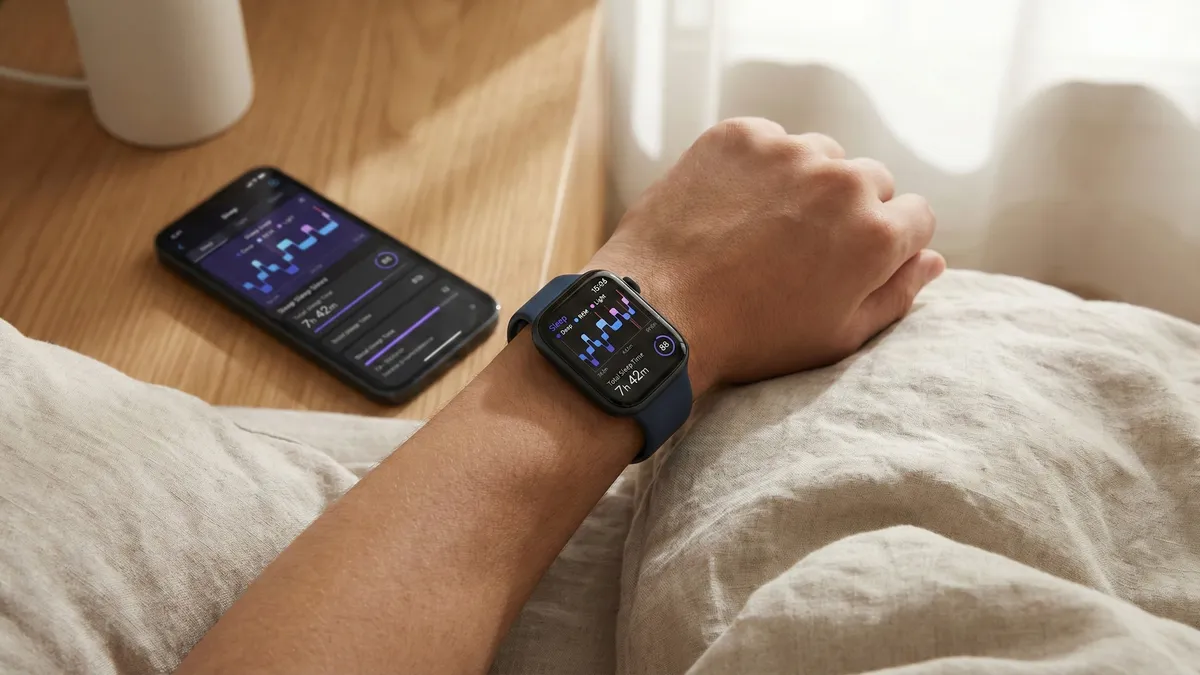
Key Takeaways
- Sleep trackers are decent at measuring total sleep time but much less reliable when they break it into stages
- Tracking can cause "orthosomnia"—sleep-score anxiety that actually makes your sleep worse (ask me how I know)
- Trackers work best for spotting patterns over weeks and months, not for grading any single night
- How you feel when you wake up is real data too—don't let a number override your own body
- Try tracking for a few weeks to learn something, then ditch it if it starts stressing you out
My twins were three weeks old when my husband strapped a Fitbit onto my wrist. "You should know how much sleep you're actually getting," he said, like I needed a gadget to tell me the answer was "not enough."
That was five years ago. Since then I've owned a Fitbit Sense, an Oura Ring (Gen 3), an Apple Watch Series 8, and briefly a Whoop 4.0 that I returned after the subscription price made me lose sleep for entirely non-scientific reasons. I have opinions about all of them. Some of those opinions are unprintable.
01 How Sleep Trackers Work
Every consumer tracker is, at its core, making educated guesses about what your brain is doing based on what your wrist (or finger) is doing. Here's how.
Accelerometer
Measures movement. Lying still? Probably asleep. Tossing around? Probably awake. It's crude, but it works better than you'd expect for detecting when you fall asleep and when you wake up.
Optical Heart Rate (PPG)
That green light on the underside of your watch? It's reading blood flow to estimate heart rate. Your heart rate variability shifts between sleep stages—dropping during deep sleep, getting irregular during REM—and the tracker uses those patterns to guess which stage you're in.
Oxygen Saturation
The Oura, newer Apple Watches, and several Fitbit models measure blood oxygen. Repeated dips overnight could suggest sleep apnea. Worth flagging to a doctor—but a consumer tracker can't diagnose anything.
Temperature Sensors
Your skin temperature drops when you fall asleep. The Oura Ring is especially aggressive about this metric—it uses temperature deviations to predict everything from illness to menstrual cycles. Results are... mixed.
Tracker vs. Sleep Lab (Polysomnography)
A real sleep study straps electrodes to your head and measures brain waves (EEG), eye movement (EOG), and muscle activity (EMG). That's how you actually know someone is in deep sleep versus REM. Consumer trackers infer all of this from motion and pulse data. The gap between those two approaches is enormous, and I wish more tracker apps were honest about it.
02 How Accurate Are They?
It depends entirely on what you're asking. Total time asleep? Reasonably close. How long you spent in deep sleep? Your tracker is basically guessing.
"Consumer devices were moderately accurate for sleep/wake detection but performed poorly for sleep staging, particularly for deep sleep."
— Zambotti et al., Sleep Medicine Reviews, 2019
I wore my Oura Ring and Apple Watch on the same hand for two weeks once. (Yes, I looked ridiculous.) On the same night, one told me I got 52 minutes of deep sleep. The other said 1 hour 38 minutes. Same wrist. Same night. That tells you everything you need to know about trusting stage data.
03 Real Benefits of Sleep Tracking
I'm not here to trash these devices. I genuinely think they can help—within limits.
The Reality Check
Before I tracked, I thought I was getting seven hours. Turns out it was closer to five and a half. Seeing the actual number in cold data was the push I needed to change my bedtime.
Trend Detection
Individual nights are noisy. But zoom out to weeks and months and real patterns emerge. I discovered I sleep measurably worse on Sundays (pre-Monday dread, apparently) and better on days I run. That's useful.
Schedule Accountability
My Oura's bedtime reminder is the only reason I stopped "just one more episode"-ing myself into midnight every night. Sometimes you need a nudge from a ring on your finger.
Catching Red Flags
A friend's Fitbit flagged repeated oxygen dips. She mentioned it to her doctor, got a proper sleep study, and was diagnosed with moderate obstructive sleep apnea. That device possibly changed her life. Possibly.
04 The Downsides of Sleep Tracking
And now the part where I tell you about the time I cried over a sleep score. (Postpartum hormones were a factor, but still.)
Morning Anxiety
I'd wake up feeling fine. Then I'd check my Oura, see a 63 readiness score, and suddenly I felt exhausted. The score didn't reflect my state—it created it. This happened more often than I want to admit.
False Precision
"You got 47 minutes of deep sleep." That number looks scientific. It's presented with two significant figures, in a nice graph. It could easily be off by 30+ minutes. The confidence the apps project is wildly out of proportion to their accuracy.
Chasing the Wrong Target
I once went to bed at 8:45 PM because I wanted a higher Oura score. I lay there for 90 minutes staring at the ceiling, which the ring dutifully logged as "restful." A high score is not the same thing as feeling good. Those are different goals.
Nocebo Effect
This one is backed by research: when people are told they slept poorly (even incorrectly), they perform worse on cognitive tests. Your tracker telling you last night was bad can literally make your day worse—whether or not it was accurate.
05 Orthosomnia: When Tracking Backfires
In 2017, Kelly Baron and her colleagues at Rush University Medical Center published a case series in the Journal of Clinical Sleep Medicine describing patients who were so fixated on their tracker data that the fixation itself was disrupting their sleep[1]. They called it orthosomnia—from "ortho" (correct) and "somnia" (sleep). The drive to achieve "correct" sleep was making these people sleep worse.
I read that paper at 2 AM while wearing an Oura Ring and felt personally attacked.
Signs You Might Have Orthosomnia
- Your stomach tightens when you reach for your phone to check last night's data
- A low score tanks your mood for the whole morning
- You felt rested when you woke up—then checked the app and suddenly felt tired
- You've skipped evening plans or changed routines specifically to improve a metric
- You've woken up in the middle of the night and checked the app to see "how it's going so far"
I hit four out of five on that list. So I took the Oura off for a month. You know what happened? I slept better. Not dramatically, but noticeably. I stopped performing sleep and just... slept.
If any of that sounds like your situation, I'd seriously consider a tracking break. The data will still be there if you want to go back.
06 Who Should (and Shouldn't) Track
Tracking Might Work for You If:
- You're genuinely curious about patterns and can look at a bad number without spiraling
- You want to test specific changes—like whether cutting alcohol or adding exercise shifts your sleep
- You need an external nudge to keep a consistent schedule (no shame in that)
- You plan to track for a defined period, learn something, then reassess
- Numbers motivate you without stressing you out
Think Twice If:
- You already struggle with sleep anxiety or insomnia
- You have a pattern of obsessing over health data (step counts, calories, HRV)
- Your morning mood depends on what the app says
- You've felt worse after checking your data than you did before checking
- Perfectionism is already a thing you deal with
The Golden Rule
If the tracker is making you sleep worse, take it off. No readiness score or sleep graph is worth actual rest. How you feel when you wake up is data. Your body is not wrong because an algorithm disagrees.
What I Tell People Who Ask Me Which Tracker to Buy
I tell them: maybe don't. Or at least, go in knowing what these things can and can't do. They're decent at telling you roughly how long you slept. They're good at revealing patterns over time. They are not measuring your sleep stages with anything close to clinical accuracy, no matter how pretty the graphs look.
Some people get a tracker, learn something about their habits, and make a real change. Others (me, for a while) get a tracker, develop a new anxiety, and lie awake wondering why their deep sleep percentage dropped. Both responses are normal. Neither one means you're doing it wrong.
Here's what I actually do now: I wear the Oura Ring, I glance at weekly trends on Sunday, and I do not check daily scores. If I wake up and feel rested, I'm rested. If my tracker disagrees, my tracker is wrong. Your body was keeping score long before any of these gadgets existed. Trust it.
Sources & Further Reading
- "Orthosomnia: Are Some Patients Taking the Quantified Self Too Far?" Journal of Clinical Sleep Medicine, 13(2), 351-354. (2017) PubMed →