
Key Takeaways
- Sleep anxiety is real and absurdly common—worrying about not sleeping can become a bigger problem than the bad sleep itself
- The harder you try to sleep, the more awake you get. Sleep wants you to stop gripping the steering wheel.
- Paradoxical intention—deliberately trying to stay awake—short-circuits the performance pressure that keeps you up
- Cognitive restructuring teaches you to talk back to the 2am catastrophe brain
- CBT-I (Cognitive Behavioral Therapy for Insomnia) outperforms sleep medication for chronic sleep anxiety, and the results stick
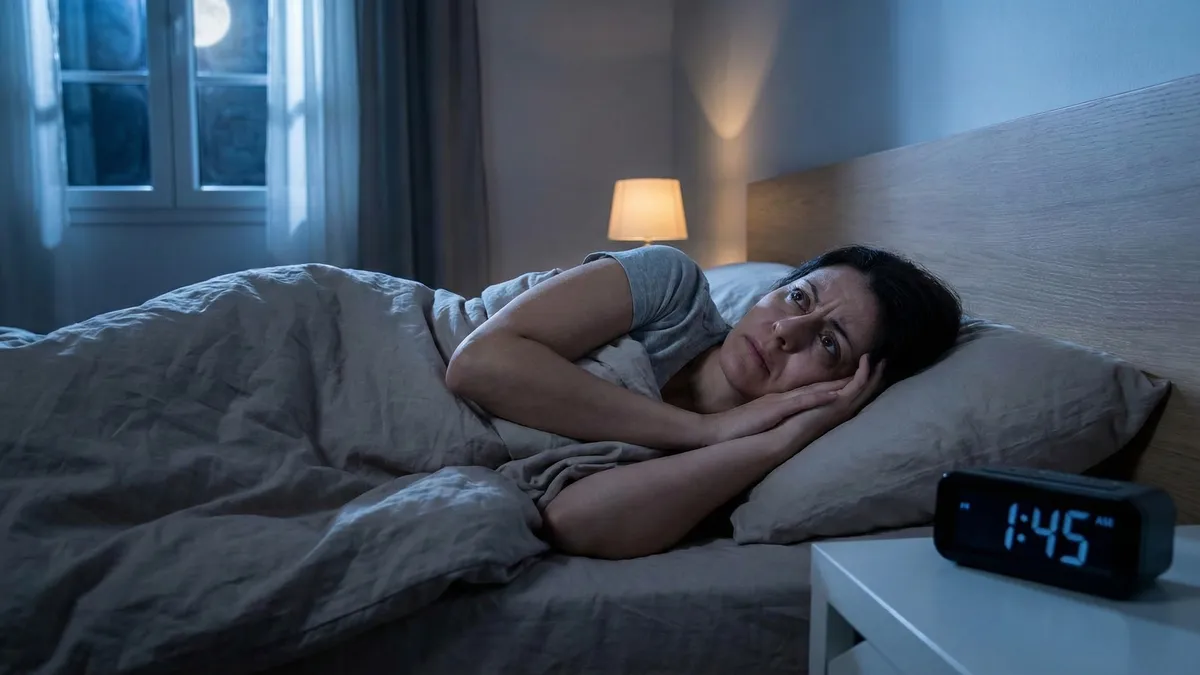
If you're reading this at 2am on your phone with the brightness turned down, I see you. I've been you. More times than I can count.
Here's what's probably happening: you need to sleep, you know you need to sleep, and that knowledge is the exact thing keeping you awake. You check the clock. 11:47pm. Your brain does the math instantly—if I fall asleep right now, that's 6 hours and 13 minutes. But you're not falling asleep. So now you're doing the math again. And again.
This is sleep anxiety. And here's the cruel joke at its center: wanting sleep pushes it away. The more desperately you need it, the faster it runs.
I learned this the hard way. After my twins were born, I went from normal sleep deprivation (brutal, but temporary) to something different—a fear of not sleeping that took on its own life. I'd dread bedtime starting around 4pm. The actual insomnia was bad, but the anticipatory dread was worse. My body would tense up the second I pulled back the covers. That's what nobody tells you: the anxiety about sleep can outlast the thing that caused the bad sleep in the first place.
01 The Vicious Cycle
Sleep anxiety runs on a feedback loop, and it's a mean one. The short version: a bad night teaches your brain that bed equals stress, and then your brain helpfully makes sure you're stressed every time you get into bed. Thanks, brain.
Bad Night
Something real causes a bad night—stress, illness, a newborn, whatever. Totally normal.
Worry Develops
You start wondering: will it happen again tonight? Bedtime stops feeling neutral.
Arousal Increases
The worry flips on your stress response. Heart rate up. Muscles tight. Your body is ready to fight a bear, not fall asleep.
Sleep Suffers
You lie there awake, which confirms the fear. See? You can't sleep. The loop tightens.
And here's what makes it truly unfair: even after the original problem goes away—the stressful project ends, the baby starts sleeping through the night—the anxiety can stick around. Your bed has become a trigger. Your brain now associates it with wakefulness and frustration, not rest[1]. (Allison Harvey's 2002 cognitive model of insomnia maps this out in painful detail.)
"Insomnia is often less about the inability to sleep and more about the excessive effort to sleep."
— Dr. Guy Meadows, The Sleep School
02 Why Sleep Anxiety Happens
A few things about sleep make it uniquely prone to this kind of anxiety spiral. And once you see them, you'll understand why "just relax" is such useless advice.
Sleep Requires Surrender
You can't effort your way into sleep. It's the opposite of every other problem in your life. Trying harder at sleep is like trying harder to fall in love. It doesn't work that way.
Performance Pressure
We've turned sleep into a KPI. Sleep trackers grade you. Wellness culture tells you eight hours or you're failing. So now you're not just tired—you're failing at being tired.
Hyperarousal
If your nervous system has been running in fight-or-flight for weeks (or months, or years), it doesn't just switch off because you put on pajamas. Your baseline is too high for sleep to happen easily.
Conditioned Response
Pavlov's dog, but make it miserable. After enough bad nights, your brain learns: bed = awake and frustrated. The pillow becomes the bell.
The Catastrophic Thinking Pattern
Sleep anxiety has a greatest hits playlist of thoughts, and your brain puts it on repeat right around the time your head hits the pillow. Tell me if you recognize any of these:
"I probably won't be able to sleep tonight."
"If I don't sleep, tomorrow will be a disaster."
"Why am I still awake? It's been 20 minutes."
"I need to fall asleep right now."
"I'm broken. Normal people don't have this problem."
Every single one of these thoughts jacks up your arousal. Your brain hears them and goes, "Oh, we're in danger? Cool, let me keep us awake to deal with it." Which is, of course, the exact opposite of what you need.
03 Breaking the Cycle
I want to be honest with you: you cannot white-knuckle your way out of this. I tried. It doesn't work. What does work—and I know this sounds backwards—is to stop fighting it. Change your relationship with sleep instead of trying to win a wrestling match with it.
The Core Principle
Stop trying to sleep. I know. Annoying advice when you're exhausted. But the goal isn't to force unconsciousness—it's to lower the alarm bells enough that sleep can come find you on its own.
The Paradox of Control
Sleep researcher Colin Espie (University of Oxford) named this the "attention-intention-effort pathway"[2]: the more attention you pay to sleep, the more intentional effort you put in, the more arousal you create. It's a trap with three doors and they all lead back to the same room.
- Effort creates arousal. Sleep needs the opposite of effort.
- Monitoring whether you're falling asleep keeps you from actually doing it—like watching a pot boil
- Trying to control sleep tells your brain the situation is a threat, which triggers even more wakefulness
04 Cognitive Techniques
These go after the thoughts themselves—the catastrophizing, the clock-math, the "I'm going to be a zombie tomorrow" spirals. Fair warning: they feel weird at first. Do them anyway.
Paradoxical Intention
Strong EvidenceThis one sounds ridiculous, so hear me out. Instead of trying to sleep, try to stay awake. Lie there with your eyes open and gently resist sleep. Broomfield and Espie's 2005 research on sleep effort[3] helps explain why this works: it removes the performance pressure entirely. You can't fail at staying awake. And without that pressure, sleep often sneaks in.
How to Practice
- Get into bed and keep your eyes open (in the dark)
- Tell yourself: "I'm going to stay awake as long as possible"
- Don't force wakefulness—just gently resist closing your eyes
- Notice how the pressure to sleep decreases
Cognitive Restructuring
Strong EvidenceYour 2am brain is a liar. Not maliciously—it's just terrible at risk assessment when it's tired and scared. Cognitive restructuring is basically learning to fact-check it.
"If I don't sleep tonight, I'll completely fail tomorrow."
"I've functioned after bad nights before. It won't be my best day, but I'll manage."
"I've been lying here for hours and I'm still awake."
"Time perception is distorted at night. Even rest is restorative."
Worry Time
Moderate EvidenceThis sounds too simple to work, but it does. Pick a 15-20 minute window earlier in the day—well before bedtime—and let yourself worry on purpose. Write it all down. Then when the worries show up at night (and they will), you can genuinely say: "I already dealt with you. You're on tomorrow's list."
How to Practice
- Set a daily "worry time" (e.g., 6pm for 15 minutes)
- Write down worries during this time, including sleep worries
- When worries arise at night, note them for tomorrow's session
- Remind yourself: "I'll deal with this at worry time, not now"
05 Behavioral Strategies
The cognitive stuff handles your thoughts. These handle what you actually do—the habits and patterns that keep the anxiety loop spinning without you realizing it.
Stimulus Control
Retrain your brain to associate bed with sleep again. Only get in bed when you're actually sleepy (not just tired—sleepy). Can't sleep after 20 minutes or so? Get up. Do something boring in dim light. Go back when your eyelids feel heavy. Yes, this is annoying. It works.
Remove Clocks
Every time you check the clock, your brain does the math and panics. Turn the clock around. Put your phone face-down across the room. Your alarm will still go off. You don't need to know what time it is at 3am. Nothing good comes from knowing.
Ditch Sleep Trackers
I know this is controversial. But if you have sleep anxiety, that morning sleep score is just giving your anxiety more ammunition. "See, you only got 4 hours of deep sleep!" You don't need a grade on something you're already stressed about.
Sleep Restriction
This one's counterintuitive: you actually spend less time in bed. It builds up sleep pressure and cuts down on the hours you spend lying awake marinating in anxiety. A 2014 review by Miller et al.[4] found strong support for this approach, but do it with professional guidance—it's intense at first.
"You don't have to sleep. You just have to be willing to not sleep while lying in bed."
— Dr. Guy Meadows
The "Can't Sleep" Protocol
This is my 2am playbook. When I'm lying there and the thoughts are spiraling, this is what I actually do (not perfectly, not every time, but enough):
Acknowledge
"I can't sleep right now. That's uncomfortable, but it's not dangerous. I'm safe. I'm just awake."
Drop the Rope
Stop trying. Seriously. Give yourself permission to just lie here awake. You're not going to fix this by clenching harder.
Redirect Attention
Move your focus outward. The weight of the blanket. The texture of the pillowcase. A distant car. Anything that isn't the inside of your own head.
Get Up If Needed
If frustration is building, get out of bed. Read something dull in dim light. Come back when your eyes start to close on their own. Not before.
06 When to Seek Professional Help
Everything above can help, and for a lot of people, it's enough. But there's a point where you need more than a blog post. No shame in that—I crossed that line myself. Here's when it's time to talk to someone:
This has been going on for more than 3 months
It's wrecking your work, your relationships, or your ability to get through a normal day
You've genuinely tried these strategies for a few weeks and nothing's budging
You're relying on alcohol or sleep meds most nights just to get through
The anxiety has spread beyond sleep—you're feeling depressed or anxious during the day too
CBT-I: The Gold Standard
Cognitive Behavioral Therapy for Insomnia (CBT-I) is what the American College of Physicians recommends as first-line treatment for chronic insomnia[5]—ahead of medication, not alongside it. It works better than sleeping pills for the long haul, and the effects last after treatment ends (pills can't say that).
You can do CBT-I in person, over telehealth, or through validated apps like Sleepio or the VA's free CBT-I Coach app. It usually takes 4-8 sessions. Success rate is around 70-80%, which is genuinely remarkable for something with no side effects.
Hey. You're Going to Be Okay.
I debated how to end this, because I remember what it felt like to read articles about sleep anxiety at 2am and feel even worse afterward. So let me just say the thing directly: this gets better. It really does.
Not overnight. (Sorry.) And not by trying harder—that's the whole problem. It gets better when you stop treating sleep like an enemy to defeat and start treating it like a scared cat that will come to you when you stop chasing it. Some nights will still be bad. You'll survive those nights. You have before.
Sleep is a biological drive. Your body knows how to do it. It's been doing it your whole life. Right now, anxiety is jamming the signal. But the signal is still there. Your only job—and I know this is the hardest thing to hear when you're exhausted—is to stop getting in its way.
And if you can't do that alone, that's not failure. That's just a sign you need a guide. There are people who do this for a living and they're good at it. Let them help.
Sources & Further Reading
- "A cognitive model of insomnia." Behaviour Research and Therapy, 40(8), 869-893. (2002) PubMed →
- "The attention–intention–effort pathway in the development of psychophysiologic insomnia." Sleep Medicine Reviews, 10(4), 215-245. (2006) PubMed →
- "Towards a valid, reliable measure of sleep effort." Journal of Sleep Research, 14(4), 401-407. (2005) PubMed →
- "The evidence base of sleep restriction therapy for treating insomnia disorder." Sleep Medicine Reviews, 18(5), 415-424. (2014) PubMed →
- "Management of Chronic Insomnia Disorder in Adults: A Clinical Practice Guideline." Annals of Internal Medicine, 165(2), 125-133. (2016) PubMed →
Recommended Resources
- The Sleep Book by Dr. Guy Meadows
- Say Good Night to Insomnia by Dr. Gregg Jacobs
- CBT-I Coach (free app from VA)
- Sleepio (digital CBT-I program)