Key Takeaways
- Alcohol helps you fall asleep faster but dramatically reduces sleep quality
- It suppresses REM sleep in the first half of the night, impairing memory consolidation
- As alcohol metabolizes, you experience rebound wakefulness—fragmented sleep in the second half
- Even moderate drinking (1-2 drinks) measurably affects sleep architecture
- Allow 3-4 hours between your last drink and bedtime for minimal impact
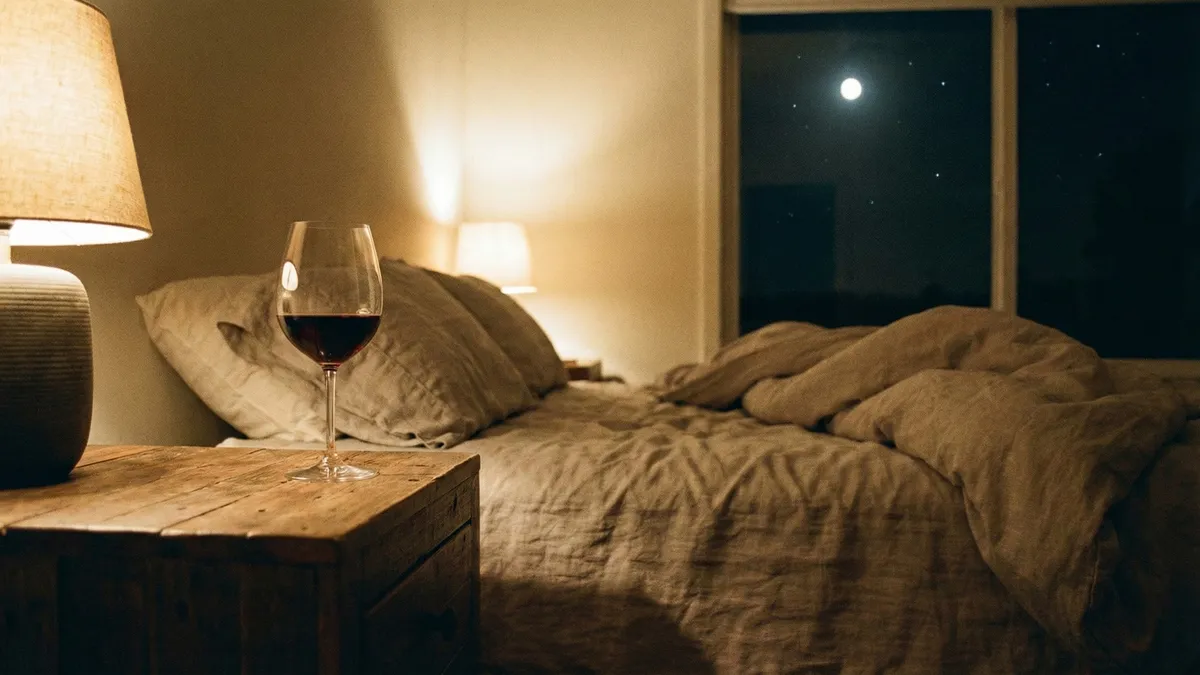
That glass of wine helps you unwind. The whiskey nightcap makes you drowsy. And alcohol genuinely is a sedative — nobody's disputing that part. The problem is what comes after.
Look, after my divorce I was pouring a generous glass of red every night and telling myself it was "self-care." Slept like a rock for the first three hours, then spent the rest of the night staring at the ceiling wondering why I felt worse than before I drank. Took me embarrassingly long to connect those dots. The research, it turns out, connected them decades ago.
01 The Alcohol Paradox
Alcohol is a sedative. It genuinely does help you fall asleep faster. This is why so many people use it as a sleep aid—the immediate effect is real[1].
But sedation is not the same as sleep. Being unconscious is not the same as restoration. Think about it this way: anesthesia also knocks you out, and nobody calls that "a good night's rest." What alcohol does to your brain throughout the night undermines everything you think you're gaining at bedtime.
First Half of Night
- Fall asleep faster
- Deeper initial sleep
- Reduced REM sleep
- More slow-wave sleep
Second Half of Night
- Frequent awakenings
- Light, fragmented sleep
- REM rebound (vivid dreams)
- Sweating, restlessness
02 What Happens in Your Brain
This is where it gets a bit technical, but stick with me — understanding the mechanism is what finally made me take this seriously. Alcohol doesn't just do one thing to your brain. It hits multiple neurotransmitter systems at once:
GABA Enhancement
Alcohol amplifies GABA, an inhibitory neurotransmitter. This creates the sedative effect—reduced brain activity and relaxation. It's why you feel drowsy.
Glutamate Suppression
Alcohol suppresses glutamate, an excitatory neurotransmitter. Your brain responds by upregulating glutamate receptors—setting up the rebound later.
Adenosine Spike
Alcohol rapidly increases adenosine (the "sleepiness" compound), making you drowsy quickly. But it's metabolized fast, removing the sleep signal.
REM Suppression
Alcohol significantly reduces REM sleep in the first half of the night. REM is critical for emotional processing and memory consolidation.
"Alcohol is one of the most powerful suppressors of REM sleep that we know of."
— Dr. Matthew Walker, Why We Sleep
03 The Second Half Problem
As your liver metabolizes alcohol (about one drink per hour), your brain chemistry rebounds. The suppressed systems come roaring back:
Metabolism Begins
Alcohol levels drop, GABA enhancement fades, glutamate surges
Fragmentation Zone
Frequent awakenings, light sleep, possible night sweats
REM Rebound
Intense, often disturbing dreams as brain tries to recover lost REM
This is why you can drink, sleep for 8 hours, and still wake up feeling unrested. The total time in bed looks fine on paper. Your sleep tracker might even say you got a full night. But your brain knows the difference — and so does your body at 7am when you feel like you've been awake for days.
04 How Much Matters?
"But I only had one drink" — yeah, I've said that too. Here's the thing: how much you drink changes the equation a lot, but even small amounts aren't free.
Light (1 drink)
Modest effects on sleep architecture. Some REM reduction, minor fragmentation. May still feel rested if consumed early enough.
Moderate (2-3 drinks)
Noticeable sleep quality reduction. Significant REM suppression, more awakenings. You'll likely feel the effects the next day.
Heavy (4+ drinks)
Severe sleep disruption. May cause sleep apnea-like breathing problems. Profound REM suppression and intense fragmentation. Next-day impairment is significant.
What Counts as "One Drink"?
• 12 oz beer (5% ABV)
• 5 oz wine (12% ABV)
• 1.5 oz spirits (40% ABV)
05 Practical Guidelines
I'm not going to tell you to stop drinking. That's your call. But if you're going to drink and you also care about how you sleep, there are ways to make this less bad:
Time It Right
Allow 3-4 hours between your last drink and bedtime. This gives your body time to metabolize most of the alcohol before you sleep.
Hydrate
Alcohol is a diuretic. Drink water between drinks and before bed to reduce dehydration-related awakenings.
Eat First
Food slows alcohol absorption, reducing the spike-and-crash pattern that disrupts sleep.
Know Your Limit
One drink rarely ruins sleep. Two drinks might. Three or more almost certainly will. Choose your occasions.
The "Nightcap" Trap
Using alcohol to fall asleep creates a dangerous cycle. You develop tolerance, need more to feel drowsy, and become dependent on it for sleep. This can rapidly become a clinical problem. If you need alcohol to sleep, speak with a healthcare provider.
So where does that leave you?
Here's what I keep coming back to: the drowsiness is real, but it's a trick. Alcohol doesn't give you sleep — it takes the first half of the night and borrows it from the second half, and your brain spends the rest of the night trying to claw back what it lost. That's not rest. That's damage control.
I still drink sometimes. I'm not going to pretend I've become some kind of monk about this. But I stopped pretending it helps me sleep, and that shift — just being honest with myself about what the trade-off actually is — changed how I approach evenings more than any rule about "stop drinking by 8pm" ever did.
If better sleep matters to you, keep alcohol away from bedtime. That's the simple version. The complicated version is that most of us already know this and do it anyway. Maybe just start noticing how you feel the morning after, and let that do the convincing.
Sources & Further Reading
- "Alcohol and sleep I: effects on normal sleep." Alcoholism: Clinical and Experimental Research, 37(4), 539-549. (2013) PubMed →