
Key Takeaways
- Caffeine has a half-life of 5-6 hours on average, but this varies wildly between individuals
- The "no coffee after 2pm" rule is too late for some people and unnecessarily early for others
- Your genetics determine whether you're a fast or slow caffeine metabolizer
- Even if you fall asleep fine, caffeine can reduce deep sleep quality by up to 20%
- The solution isn't to quit caffeine—it's to find your personal cutoff time
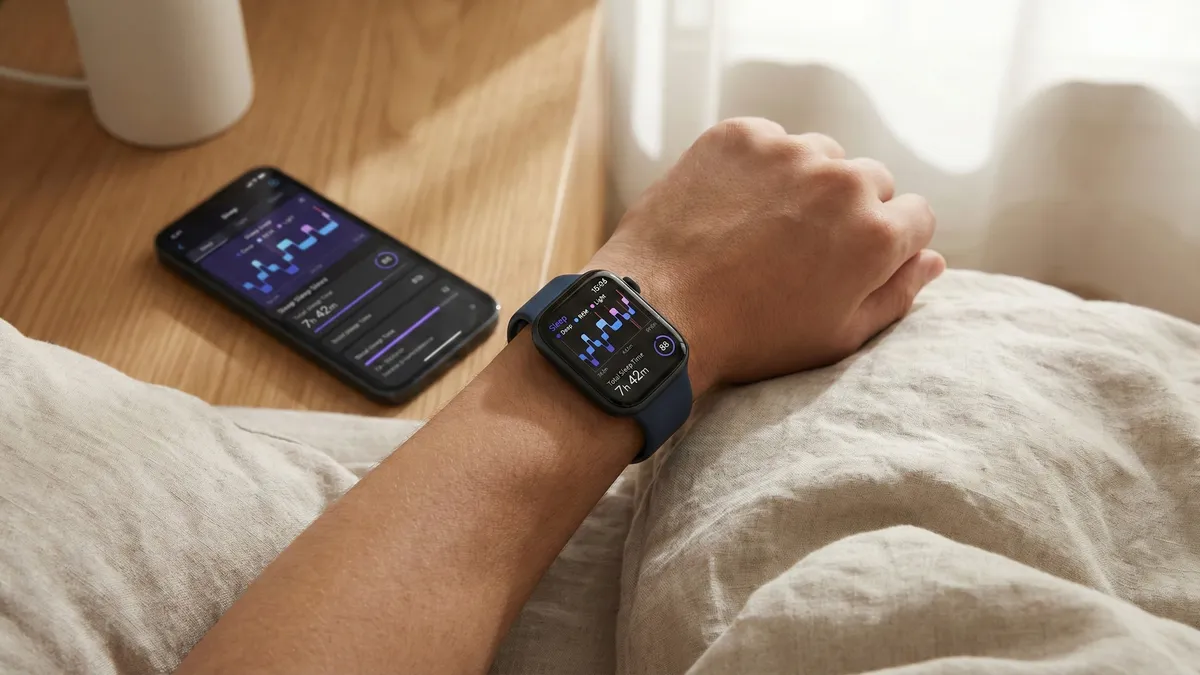
Last October I got a sleep tracker. First week wearing it, I noticed something weird: on days I had my afternoon espresso, my deep sleep dropped by almost half. I was getting seven hours in bed and waking up feeling like I'd gotten four.
That pissed me off, honestly. I'd already fixed the late-night screens, the room temperature, the whole sleep hygiene checklist. And this entire time, my 3pm coffee habit was quietly undoing most of it.
You've probably heard "no coffee after 2pm." It's everywhere. But where does that number actually come from? Is it real science or just one of those things that sounds right so everyone repeats it? I spent a few weeks going through the research, and the answer is more complicated than I expected—and your optimal caffeine cutoff might be hours away from mine.
01 How Caffeine Actually Works
Quick primer, because this matters for everything that follows.
Throughout the day, a chemical called adenosine builds up in your brain. Think of it as "sleep pressure"—the longer you're awake, the more adenosine accumulates, and the sleepier you feel. When you finally sleep, your brain clears out the adenosine, and you wake up refreshed.
Caffeine's Trick
Caffeine molecules are shaped almost identically to adenosine. They slip into adenosine receptors in your brain, blocking the real adenosine from binding. Result: you don't feel tired, even though the tiredness is still building up behind the scenes.
Here's the problem: caffeine doesn't eliminate adenosine—it just masks it. When the caffeine eventually wears off, all that accumulated adenosine hits your receptors at once. That's the infamous "caffeine crash." You didn't gain energy. You delayed the bill.
"Caffeine is not a food supplement. It is the most widely used (and abused) psychoactive stimulant in the world."
— Dr. Matthew Walker, Why We Sleep
02 The Half-Life Problem
This is where it gets annoying.
Caffeine doesn't just "wear off" after a few hours. It follows what pharmacologists call a half-life—the time it takes for your body to eliminate half of the caffeine in your system. And the numbers are worse than most people realize.
Let's do the math. Say you drink a large coffee (200mg caffeine) at 3pm:
That afternoon coffee? At 2am, you've still got a cup of tea's worth of caffeine rattling around in your brain. Research shows even those low levels mess with your sleep architecture[1].
The Hidden Cost: Sleep Quality
This is the part that got me. You can fall asleep just fine with caffeine in your system. You'll swear up and down you slept great. But a 2013 study in the Journal of Clinical Sleep Medicine tells a different story[2].
"Caffeine taken 6 hours before bedtime reduced total sleep time by more than 1 hour and significantly decreased sleep efficiency. Participants were largely unaware of this disruption."
— Drake et al., 2013Read that again: participants were largely unaware. They lost over an hour of sleep and had no idea.
That was me for years. I'd tell people caffeine didn't affect my sleep. I was wrong—I just couldn't feel the damage. Caffeine particularly suppresses deep sleep (slow-wave sleep), which is the phase where your body repairs itself and your brain consolidates memories. You lose the most restorative part of the night and don't even know it.
03 Your Genetics Matter (A Lot)
So why does your coworker pound espresso at 4pm and sleep like a baby while you're staring at the ceiling after a noon latte? Genetics.
Caffeine metabolism varies dramatically between people, and the main driver is a liver enzyme called CYP1A2. Depending on which variant of this gene you have, you fall into one of two categories[3]:
Fast Metabolizers (~50% of people)
- Half-life of 3-4 hours
- Can drink coffee later in the day
- Feel caffeine effects for shorter time
- May need more coffee for same effect
Slow Metabolizers (~50% of people)
- Half-life of 7-9+ hours
- Need much earlier cutoff times
- Caffeine effects last longer
- Higher risk of sleep disruption
If you're a slow metabolizer, that 2pm coffee might as well be an 8pm coffee for a fast metabolizer. Noon might be too late for you. I know that sucks to hear.
Other Factors That Slow Metabolism
Oral Contraceptives
Can nearly double caffeine half-life in some women
Pregnancy
Half-life can extend to 15+ hours in third trimester
Diet
Cruciferous vegetables speed metabolism; grapefruit slows it
Smoking
Smokers metabolize caffeine nearly twice as fast
04 Finding Your Personal Cutoff
You can get a genetic test if you want. But honestly? There's a free way to figure this out that takes two weeks and a notes app.
The 2-Week Caffeine Experiment
- Week 1: Set a strict 12pm caffeine cutoff. No exceptions. Track your sleep quality each morning (1-10 scale), noting how you feel upon waking.
- Week 2: Move the cutoff to 2pm. Same tracking.
- Compare: Did your sleep quality change? Did you wake up feeling different? If Week 1 was notably better, you're likely a slow metabolizer.
Want more precision? Extend the experiment. Try 10am for a week, then 11am, then noon, tracking each window for 5-7 days. You're looking for the point where your sleep quality drops off. It's there. You just have to find it.
Signs You're Cutting Off Too Late
- Taking more than 20 minutes to fall asleep
- Waking up feeling groggy despite 7-8 hours in bed
- Frequent wake-ups during the night
- Feeling like you need coffee immediately upon waking
- Sleep tracker showing low deep sleep percentages
05 Practical Tips for Coffee Lovers
I'm not going to tell you to quit caffeine. I didn't. But I did stop using it like an idiot.
Do This
- Wait 90 minutes after waking for your first coffee—let natural cortisol wake you up first
- Front-load your caffeine—have your strongest coffee in the morning
- Switch to half-caff or tea after noon if you need an afternoon boost
- Stay hydrated—dehydration amplifies caffeine's effects on sleep
- Track your experiments—use a sleep app or simple journal
Avoid This
- Coffee as a sleep substitute—it's masking a problem, not solving it
- Hidden caffeine sources—chocolate, some medications, energy drinks
- Assuming you're immune—even if you fall asleep fine, your deep sleep suffers
- Caffeine late to "push through"—you're borrowing from tomorrow's energy
The Decaf Bridge
I know, I know. "Decaf? Really?" Yeah. Look—I was skeptical too. But if you love the ritual of afternoon coffee (and I do, it's half the reason I'm a functional person after lunch), decaf scratches that itch more than you'd expect. It still has 2-15mg of caffeine versus 95-200mg in regular, which is usually low enough to leave your sleep alone. You get the warm mug, the taste, the excuse to take a break. You just don't pay for it at 2am.
Figure Out Your Number
The "no coffee after 2pm" rule is a fine starting point. But that's all it is—a starting point. Your genetics, your medications, your individual biology all change how long caffeine hangs around in your system.
For roughly half the population, 2pm is actually too late. For the other half, it's unnecessarily conservative. There's no way to know which camp you're in without testing it yourself. Two weeks. A notes app. That's it.
I'm a slow metabolizer. My cutoff is 11am now, which felt absurd when I started. But I sleep better than I have since my twenties, and I stopped needing that second coffee to get through the afternoon—because the first one actually works when you're not running on garbage sleep.
Sources & Further Reading
- "Caffeine attenuates waking and sleep electroencephalographic markers of sleep homeostasis in humans." Neuropsychopharmacology, 29(10), 1933-1939. (2004) PubMed →
- "Caffeine effects on sleep taken 0, 3, or 6 hours before going to bed." Journal of Clinical Sleep Medicine, 9(11), 1195-1200. (2013) PubMed →
- "Functional significance of a C→A polymorphism in intron 1 of the cytochrome P450 CYP1A2 gene." British Journal of Clinical Pharmacology, 47(4), 445-449. (1999) PubMed →
Recommended Resources
- Why We Sleep by Matthew Walker, PhD (Chapter on caffeine)
- Huberman Lab: "Using Caffeine to Optimize Mental & Physical Performance"
- Sleep Foundation: Caffeine and Sleep