


Key Takeaways
- SAD shifts your circadian timing later — reduced winter light delays your internal clock, making you sleepy earlier and groggy longer
- Melatonin overproduction in winter's longer darkness is likely the main driver of hypersomnia and low energy in SAD
- Light therapy works by suppressing melatonin and resetting circadian phase — but timing matters: morning use is essential
- SAD can cause either hypersomnia (sleeping too much) or insomnia — they share the same circadian root cause but present differently
- Exercise is a legitimate circadian anchor and mood stabilizer — not just a lifestyle recommendation, a genuine mechanism
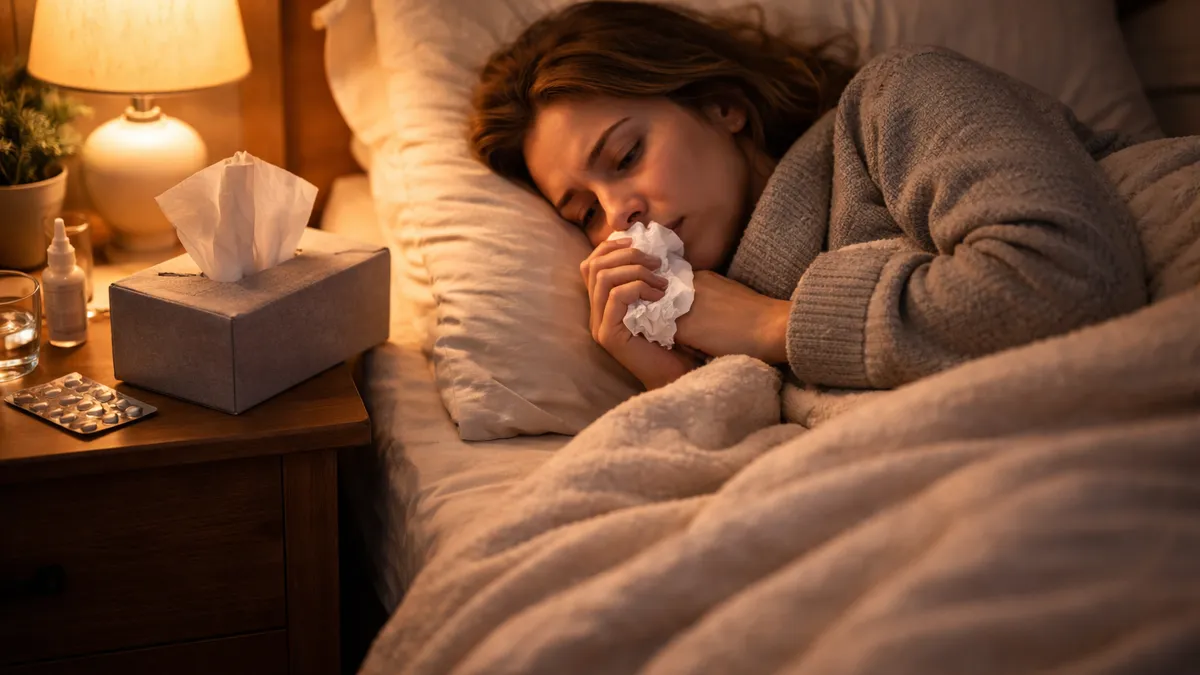
Every November I watch the same thing happen to people around me. The energy drops. The motivation goes. The sleep gets weird — either they're exhausted by 7pm and sleeping 10 hours and still tired, or they're lying awake anxious in the dark. This isn't weakness or just "the winter blues." The circadian biology behind seasonal affective disorder is genuinely interesting, and understanding it makes the treatment options make much more sense.
I spent part of my grad work looking at circadian disruption patterns, and SAD is a fascinating case because it shows how tightly our mood, energy, and sleep quality are all tied to light availability. You can't fully separate the sleep problems from the mood problems — they come from the same source.
01 How Reduced Light Shifts Your Clock
Your circadian system is anchored primarily by light hitting specialized photoreceptors in your retinas — not the rods and cones that handle vision, but a separate population called intrinsically photosensitive retinal ganglion cells (ipRGCs). These cells send signals directly to the suprachiasmatic nucleus (SCN), the master circadian clock in your hypothalamus[1].
In winter, particularly at higher latitudes, the light signal weakens. Shorter days, lower sun angle, more cloud cover. The SCN receives fewer and weaker light inputs to lock onto. Without a strong anchor, your circadian clock tends to drift — typically later in the day. Your natural sleep pressure builds earlier, your melatonin onset starts earlier, and your body wants you to wake up later.
Summer Circadian Pattern
Winter Circadian Pattern (SAD)
The shift isn't just about feeling tired earlier. The entire architecture of your sleep changes. REM sleep timing shifts. Deep sleep patterns change. And critically, the circadian mismatch between your internal clock and the external world produces many of the same effects as chronic jet lag — fatigue, brain fog, mood dysregulation, metabolic disruption.
02 The Melatonin Overproduction Problem
The leading hypothesis for SAD's core mechanism is the "phase shift" model combined with what's called the "photoperiodic" hypothesis: in winter's longer nights, melatonin is secreted for a longer duration each night. People with SAD may be unusually sensitive to this extended melatonin window[2].
Melatonin doesn't cause sleepiness directly — it's a timing signal, not a sedative. But it does shift when you feel sleepy and alert, and extended melatonin duration in winter keeps many SAD patients in a physiological state that feels like perpetual pre-sleep grogginess. This is why hypersomnia is the more common sleep presentation in SAD: you're sleeping a lot but you still feel exhausted, because the melatonin signal is telling your body it's still "nighttime" well into the morning.
Hypersomnia vs. Insomnia in SAD
SAD doesn't always mean sleeping too much. Some people with SAD experience insomnia — typically because the delayed circadian timing creates a mismatch with required wake times, similar to delayed sleep phase disorder. Both presentations share the same root: disrupted light input driving circadian phase drift.
Hypersomnia (more common)
- Sleeping 10-12 hours but still tired
- Extreme difficulty waking in the morning
- Feeling unrefreshed despite long sleep
Insomnia (less common)
- Lying awake despite feeling exhausted
- Clock mismatch: sleepy at 7pm, wired at midnight
- Early morning awakening with anxiety
03 Light Therapy: What It Does and Why Timing Matters
Light therapy works. It has among the best evidence of any SAD treatment, and for sleep disruption specifically it's been well-validated in randomized controlled trials. A 2015 JAMA Psychiatry study found it equivalent to antidepressants for SAD, and the combination of both was superior to either alone[3].
The mechanism is exactly what you'd expect from the circadian biology: bright light exposure suppresses melatonin and shifts the circadian phase earlier. The 10,000 lux standard comes from research showing that's roughly the minimum intensity needed to reliably shift circadian timing in humans. Regular indoor light (200-500 lux) doesn't cut it — you need something close to outdoor daylight intensity.
Intensity
10,000 lux at the recommended distance. Lower-intensity boxes require longer exposure times and have weaker evidence.
Timing (Critical)
Within 30 minutes of waking, ideally before 8am. Evening use can backfire, delaying your clock further. This is the most commonly missed detail.
Duration
20-30 minutes per session. You don't stare directly at the light — position it in your visual field while eating, reading, or having coffee.
Consistency
Daily use, starting in autumn before symptoms peak. Most people notice improvement within 1-2 weeks; full effects by 4 weeks.
"Light therapy at night is worse than no light therapy — you'd be delaying the very clock you're trying to advance."
— Why the instruction booklet that came with your light box actually matters
04 Dawn Simulators and Vitamin D
Dawn simulators are alarm clocks that gradually increase light intensity over 20-30 minutes before your target wake time, simulating sunrise. The evidence for these is genuinely decent — a 2001 study in Biological Psychiatry found they were superior to standard 10,000 lux light therapy for sleep quality specifically (though bright light boxes remained better for mood overall)[4].
The mechanism makes sense: the gradual light increase during the final sleep cycles primes your circadian system for waking before consciousness arrives. For people who have extreme difficulty waking in winter mornings, dawn simulators can be a gentler entry point than forcing yourself out of bed to sit in front of a light box.
About vitamin D: the evidence for vitamin D supplementation as a primary SAD treatment is much weaker than often claimed. Vitamin D deficiency does correlate with depression and is common in winter, and correcting a genuine deficiency is worth doing. But taking vitamin D if you're not deficient has not been shown to reliably improve SAD symptoms. It's not a substitute for addressing the light and circadian piece.
Should You Get Your Vitamin D Tested?
If you have SAD symptoms and haven't had a 25-OH vitamin D test, it's worth doing. Deficiency is genuinely common in winter at higher latitudes and worth correcting. But go into it with realistic expectations — fixing a vitamin D deficiency may improve your general health and energy somewhat, but it's unlikely to resolve significant SAD symptoms on its own.
05 Exercise as a Circadian Anchor
Exercise is one of those recommendations that gets dismissed as obvious — of course exercise is good for you. But I want to be specific about why it matters for SAD in a way that goes beyond general health advice: exercise is a genuine circadian zeitgeber (time-giver), meaning it directly influences circadian phase[5].
Morning exercise in particular combines the phase-advancing effect of physical activity with outdoor light exposure. Even overcast winter sky delivers 1,000-5,000 lux — less than a light box but substantially more than indoor light, and enough to contribute meaningfully to circadian anchoring. A 30-minute morning walk isn't just good exercise; it's literally providing the light cue your SCN needs.
Morning Outdoor Exercise
Combines light exposure + circadian phase advance effect. Even cloudy days provide useful lux. Best timing for SAD.
Afternoon Exercise (Indoors)
Provides mood and sleep quality benefits without the circadian anchoring. Still valuable, but misses the light piece.
Evening High-Intensity Exercise
Can delay sleep onset by raising core temperature and cortisol. Probably not helpful for SAD's already-disrupted sleep timing.
The evidence from SAD-specific exercise trials is smaller than the light therapy literature, but a meta-analysis found that exercise interventions produced clinically meaningful reductions in SAD symptoms — comparable in effect size to light therapy in some comparisons. The combination of morning outdoor exercise and a light therapy box gives you the most robust intervention package available without pharmacology.
The circadian anchor problem, and how to solve it
SAD isn't just "being sad in winter." It's your circadian system losing the strong light cues it needs to keep your internal clock in sync with the external world. That desynchrony cascades into sleep disruption, mood dysregulation, metabolic changes, and the profound fatigue that doesn't respond to sleeping more.
The good news is that the underlying mechanism points directly to effective solutions. Morning bright light exposure — whether from a 10,000-lux box, a dawn simulator, or actual outdoor time — directly addresses the circadian problem. Exercise reinforces it. Consistent sleep and wake times prevent further drift.
If you try nothing else, start with a light box every morning. 20-30 minutes, within half an hour of waking, before 8am. Do that consistently for three to four weeks before concluding it doesn't work — the circadian effects are cumulative, not immediate.
Sources & Further Reading
- "Melanopsin-containing retinal ganglion cells: architecture, projections, and intrinsic photosensitivity." Science, 295(5557), 1065-1070. (2002) PubMed →
- "The circadian basis of winter depression." Proceedings of the National Academy of Sciences, 103(19), 7414-7419. (2006) PubMed →
- "Efficacy of bright light treatment, fluoxetine, and the combination in patients with nonseasonal major depressive disorder." JAMA Psychiatry, 73(1), 56-63. (2016) PubMed →
- "Dawn simulation and bright light in the treatment of SAD: a controlled study." Biological Psychiatry, 50(3), 205-216. (2001) PubMed →
- "Effects of exercise on sleep." Clinics in Sports Medicine, 24(2), 355-365. (2005) PubMed →